
WobSongo, an AI rebuilding trust inthe age of Misinformation - A Scalable,Youth-Led Solution
How Burkina Faso is turning the infodemic into an opportunity for equity, resilience, and youth empowerment
A silent crisis shaping a generation
In today’s digital age, young people are no longer just exposed to information, they are immersed in it. In Burkina Faso, a growing proportion of adolescents and young people, particularly those connected through mobile phones and social media are exposed to a complex digital ecosystem where unverified, emotionally charged, and often harmful content circulates widely, frequently outpacing evidence-based information.
Emerging trends suggest that a significant share of connected youth, estimated between 60% and 80% in urban and peri-urban settings, regularly encounter misinformation through platforms such as TikTok, Facebook, and Instagram, shaping their perceptions, decisions, and social interactions. (Estimate based on triangulation of GSMA mobile access data, DataReportal social media usage trends, and WHO/UNICEF evidence on youth exposure to misinformation.)
This infodemic acts as a multiplier of inequalities, exacerbating vulnerabilities and widening gaps in access to reliable information. It disproportionately affects:
Adolescent girls, exposed to harmful norms around sexuality, body image, and reproductive health
Young people in fragile settings, operating in contexts marked by limited access to reliable information and deeply rooted taboos surrounding sexual and reproductive health.
Students, whose well-being, confidence, and decision-making processes are directly influenced by the information they consume,
Without intervention, misinformation fuels:
The normalization of stigma and gender-based violence
The adoption of risky health behaviors
The weakening of trust in health systems and public institutions
Slowly, misinformation became a systemic risk
Late at night in Ouagadougou, a 16-year-old girl scrolls through her phone.
Between entertainment and social content, she encounters a stream of messages about contraception, fertility, and relationships, fragmented, contradictory, and emotionally charged. She also comes across a flood of short videos talking about relationships, bodies, and “how to be attractive.”
Some of these videos go further.
They tell her that her femininity is a “means of making a living”.
That her body is a “shop”.
And that she needs to make this “shop” more attractive, using products, practices, and tricks that are often harmful to her sexual and reproductive health.
These messages are repeated, normalized, and shared among peers.
They are catchy. They feel real. They feel true.
But they are misleading.
Fragmented, contradictory, and emotionally charged, this content is shaping beliefs, behaviors, and life choices, often at the expense of young girls’ health, dignity, and future.
This experience reflects a broader reality.
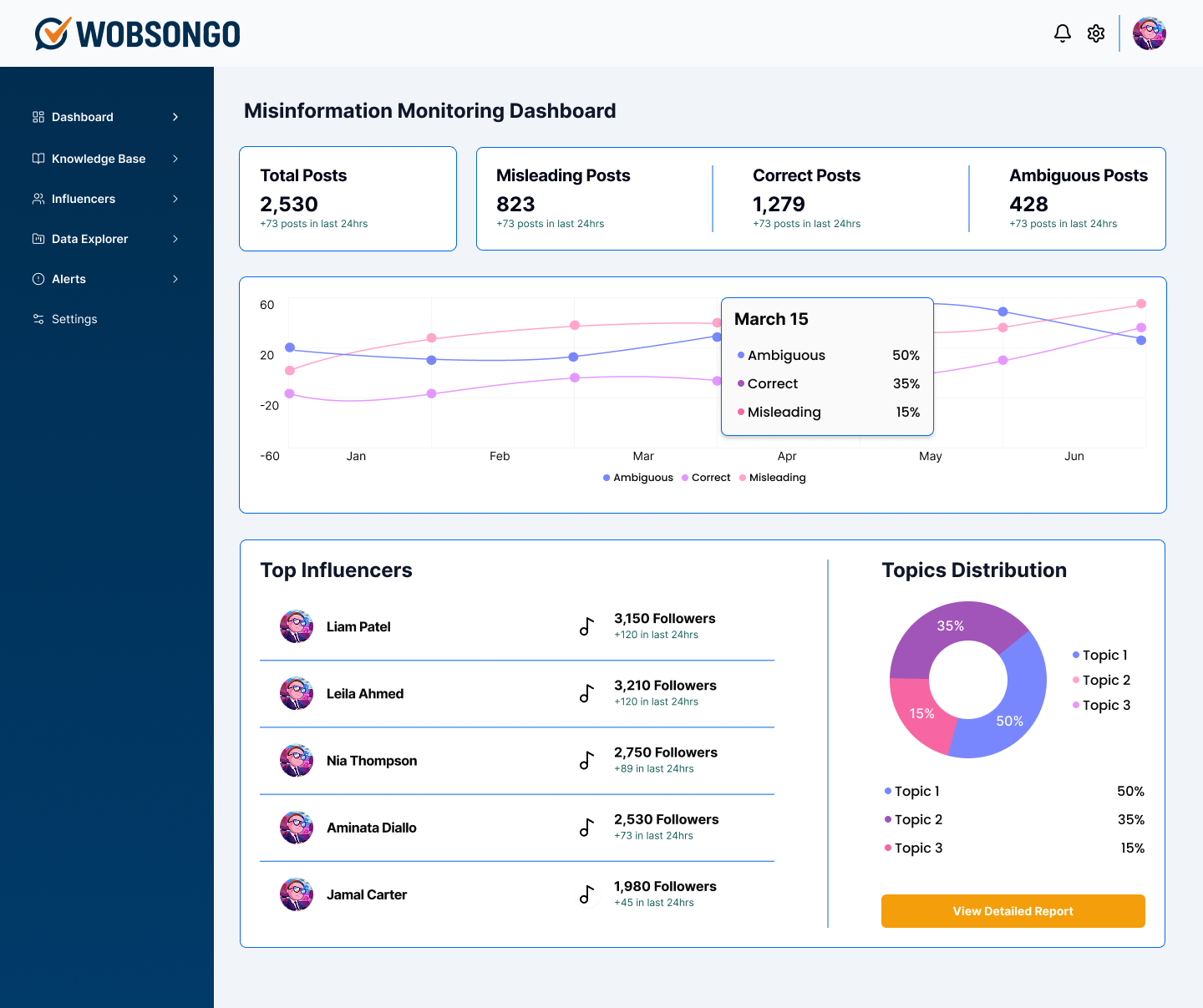
WobSongo: from fragmented information to actionable intelligence
Across Burkina Faso, young people engage daily with a rapidly evolving digital ecosystem characterized by:
Instant and continuous information flows
Limited mechanisms for verification
High levels of peer-driven content amplification
Within this environment, misinformation follows identifiable patterns of rapid diffusion and strong engagement, contributing to a growing infodemic now recognized as a major threat to public health and social cohesion.
Its effects are concrete and far-reaching:
Increased exposure to harmful norms and misleading narratives
Reinforcement of gender and social inequalities
Distortion of health-seeking behaviors and decision-making
Progressive erosion of trust in institutions and systems
WobSongo emerges as a strategic response to this evolving challenge.
Beyond a digital platform, it functions as a real-time social intelligence system.
Its ambition is both operational and transformative: to enable young people to navigate information with clarity and confidence, while equipping institutions with the tools to respond in a timely, targeted, and effective manner.
Built on blockchain technology, WobSongo transforms how information is accessed, verified, and acted upon.
For young people, it creates a new reflex: verify before believing, verify before sharing.
Through transparent and traceable data systems, users can assess the reliability of content, distinguish facts from misinformation, and make informed decisions before engaging with or amplifying information.
At the institutional level, WobSongo functions as a real-time early warning and decision-support system.
As illustrated in the dashboard:
Content is continuously analyzed across platforms
Misinformation is detected, categorized, and scored
Alerts are generated based on risk level and thematic sensitivity
Trends and emerging narratives are tracked in real time
This enables institutions to:
anticipate harmful information flows
respond rapidly with targeted communication
prioritize high-risk topics and vulnerable groups
WobSongo bridges the gap between individual critical thinking and institutional intelligence, creating a shared ecosystem of trust, accountability, and timely action.
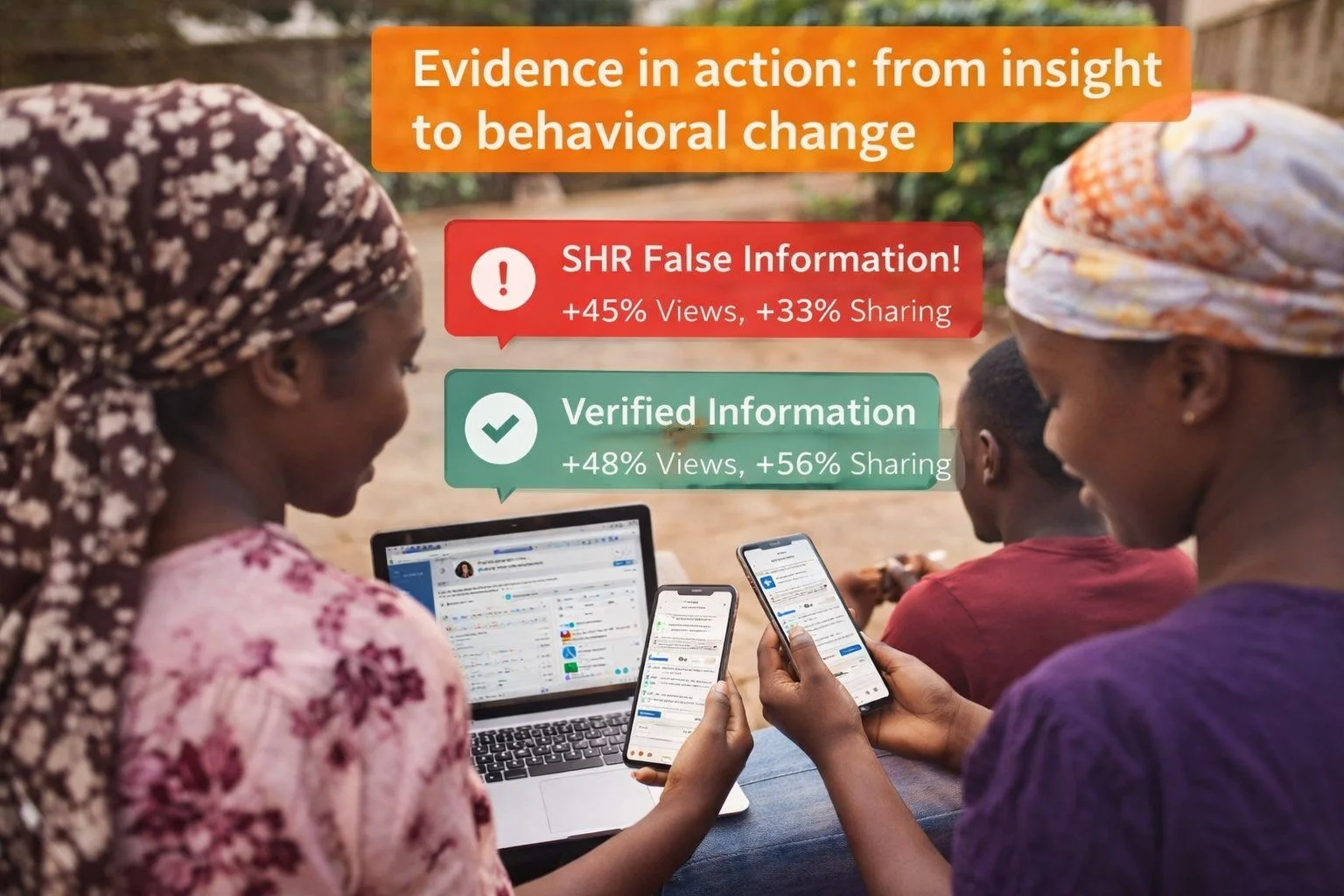
Evidence in action: from insight to behavioral change
Preliminary findings from the youth survey and the initial analysis of circulating short-form videos confirm a critical pattern: misinformation follows structured and intentional dynamics, rather than random distribution.
Evidence suggests that a significant share of misleading content is deliberately designed to influence behaviors, particularly by promoting risky sexual practices while simultaneously marketing so- called “natural” contraceptive solutions, often lacking scientific validation.
Key insights include:
High circulation of SRHR-related misinformation, particularly around contraception, fertility, and sexual performance, with recurring narratives encouraging unsafe or unverified practices
Content strategies that combine emotional appeal, peer identification, and economic framing (e.g., positioning the female body as a source of income), increasing susceptibility among adolescents
Strong engagement with misleading short-form content, frequently generating higher levels of shares, likes, and comments than evidence-based information
Rapid propagation within peer networks, especially among adolescents aged 15-17, amplifying both reach and perceived credibility
At this stage, while WobSongo is not yet fully deployed, early interactions and pilot engagements already point to promising behavioral shifts.
A notable signal is emerging from early interactions with a small group of young people engaged as part of our exploratory work to better understand their digital environments and information behaviors.
Within this group, a new reflex is beginning to take shape: a growing tendency to question content and actively seek ways to verify information before engaging with or sharing it.
Through the introduction of the FOCUS methodology, they are starting to strengthen their critical thinking capacities, learning to distinguish between facts, beliefs, and misinformation. While these changes are not yet reflected in large-scale platform metrics, they are observable through evolving attitudes, discourse, and engagement patterns within this cohort.
Rather than passively consuming and amplifying content, these young users are progressively positioning themselves as active evaluators of information.
These early signals, though qualitative and drawn from a limited sample, point to the foundation of a deeper transformation. As WobSongo scales, these behaviors have strong potential to translate into measurable outcomes, reduced circulation of harmful misinformation, increased engagement with verified content, and more informed health-related decision-making.

What begins as a reflex can become a norm. And at scale, a norm can transform an entire information ecosystem.
Making inequalities visible and actionable
Beyond analyzing information flows, WobSongo reveals the structural inequalities that shape both exposure to misinformation and vulnerability to its effects.
Data from the preliminary survey and content analysis highlight a disproportionate exposure of adolescent girls to harmful narratives related to sexuality and reproductive health. These narratives often normalize risky practices, reinforce harmful gender norms, and promote solutions that may undermine their health and autonomy.
At the same time, young people in low-connectivity or fragile environments face constrained access to reliable, evidence-based information, increasing their reliance on peer-shared and unverified content.
A high-leverage investment for systemic transformation
Cultural and social norms further influence how information is interpreted, internalized, and disseminated, sometimes reinforcing misinformation cycles rather than disrupting them.
By making these dynamics visible, WobSongo transforms fragmented data into actionable intelligence.
This enables institutions, educators, and partners to design targeted, context-sensitive, and equity-driven interventions, addressing both:
access to reliable information
and the capacity of young people to critically engage with what they consume
In doing so, WobSongo will tackle misinformation while addressing the root drivers of vulnerability and inequality within the information ecosystem.
WobSongo stands as a strategic, cross-sectoral accelerator capable of generating multiple, interconnected outcomes from a single investment.
By simultaneously strengthening health literacy, critical thinking, and information integrity, it reduces exposure to harmful misinformation while enhancing the protection and empowerment of young people, particularly girls. At the same time, it reinforces education systems, supports safer learning environments, and contributes to rebuilding trust between youth and public institutions.
This integrated impact pathway positions WobSongo at the intersection of digital health, education, gender equality, and governance.
WobSongo represents a high-return investment in digital public health, youth resilience, and social stability.
From reactive systems to anticipatory governance
WobSongo introduces a fundamental shift in how misinformation is understood and addressed.
It enables a transition from reactive responses—often delayed and fragmented—towards anticipatory, real-time governance of information ecosystems.
Through its analytics and dashboards, decision-makers are equipped to:
detect emerging narratives at an early stage
identify populations most at risk
adapt communication and intervention strategies dynamically
This positions WobSongo as a critical tool for data-driven, forward-looking governance, aligned with the demands of an increasingly digital and interconnected world.
Scaling the impact: a strategic moment
WobSongo is at a pivotal stage of its development:
The model demonstrates strong conceptual and operational relevance
Initial engagements confirm both the urgency of the need and the receptivity of target users
The foundations for scale are already in place
Strategic investment at this stage will enable:
expansion across regions and population groups
strengthening of AI capabilities, including local language processing
deeper integration within education, health, and community systems
scaling of youth-led engagement models and ambassador networks
Investing in WobSongo means investing in resilient societies
In a context where information directly shapes behaviors, opportunities, and life trajectories, WobSongo offers a decisive advantage:
The ability to strengthen trust, reduce inequalities, and empower a generation to make informed, autonomous decisions.
WobSongo goes beyond technological innovation.
It represents a systemic approach to social transformation, grounded in data, equity, and youth agency.
Co-developed with ImpactScope and supported by the UNICEF Innovation Fund, WobSongo is designed for one purpose:
Enabling a generation to think critically, act consciously, and shape a more resilient future.